

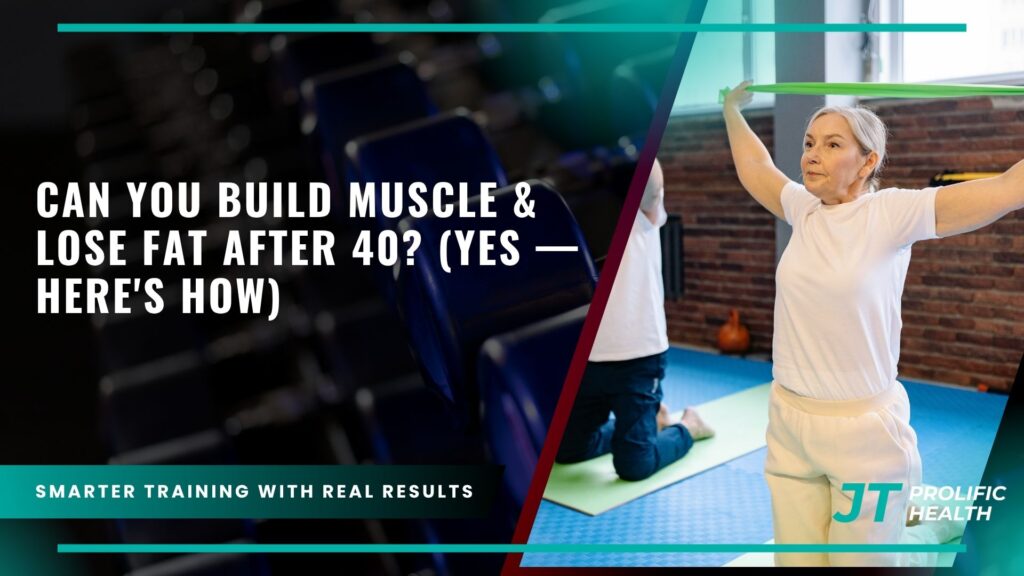
The question of can you build muscle and lose fat after 40comes loaded with assumptions, most of them discouraging and most of them wrong. There is a persistent cultural narrative that the body after 40 is essentially in managed decline, that meaningful physical transformation is a young person’s project, and that the most realistic goal for anyone past that marker is simply to slow the deterioration. That narrative is not supported by the research, and it is directly contradicted by what happens inside the coaching practice atProlific Healthwith Richmond and Vancouver clients in their 40s, 50s, and beyond every single week.
The honest answer to whether you can build muscle and lose fat after 40 is yes, with important qualifications about how the approach needs to differ from what works at 25. The physiological changes that come with age are real: testosterone and estrogen levels shift, recovery takes longer, muscle protein synthesis rates change, and the consequences of poor programming are more immediate and harder to reverse. None of those changes make body recomposition impossible. They make the quality of the programming and the coaching relationship significantly more important than it was at an earlier starting point.
Clients from Broadmoor and Seafair who arrive atProlific Healthin their mid-40s having spent years believing their best physical results were behind them consistently discover otherwise within the first few months of a properly designed program. This article explains what the science actually says, what changes in the approach after 40, and what a structured coaching relationship makes possible that self-directed training at this life stage rarely delivers.
Key Takeaways
- You can build muscle and lose fat after 40 with a properly designed program, though the approach requires meaningful adjustments from what works at a younger starting point.
- Recovery management becomes the most critical programming variable after 40, as the consequences of insufficient recovery are more immediate and more significant than at earlier ages.
- Strength training is the non-negotiable foundation for body recomposition after 40, producing hormonal, metabolic, and structural adaptations that cardio-only approaches cannot replicate.
- Nutrition quality and protein intake become more important, not less, after 40, as muscle protein synthesis rates require deliberate nutritional support to drive meaningful muscle development.
- Self-directed training after 40 carries a higher risk of overtraining, injury, and wasted effort than at younger starting points, making professional coaching a more consequential investment at this life stage.
- Results for clients over 40 working with a qualified coach appear within six to eight weeks for energy and movement quality, with body composition changes becoming measurable across four to six months of consistent, progressive work.
What the Research Actually Says About Body Recomposition After 40

Can you build muscle and lose fat after 40in a physiologically meaningful way? The research says yes, and the mechanisms through which it happens are well understood. Adults in their 40s and beyond who engage in structured resistance training build muscle tissue measurably, improve body composition significantly, and experience metabolic adaptations that produce long-term fat loss independent of dramatic caloric restriction.
The caveat the research also makes clear is that the rate of muscle protein synthesis in response to a training stimulus declines modestly with age, which means that the nutritional and recovery conditions surrounding training become more important at 40 than they were at 25. A younger lifter can build muscle reasonably well despite suboptimal protein intake, inconsistent sleep, and compressed recovery windows. A client over 40 attempting the same approach will find those variables matter more, not because the body stops responding to training but because the optimal conditions for that response become less forgiving of neglect.
The other well-documented change after 40 is the shift in hormonal environment. Declining testosterone in men and estrogen and progesterone fluctuations in women affect the anabolic signaling that supports muscle development and fat metabolism. Those changes are real and meaningful. They are also responsive to the training stimulus that structured resistance training provides. Well-designed strength training programs produce hormonal adaptations in adults over 40 that partially offset age-related declines, which is one of the physiological reasons the investment in professional coaching becomes more consequential rather than less at this life stage. For a broader look at how older adults in Richmond and Vancouver respond to structured training, this resource onpersonal training for adults over 40 in Vancouvercovers the relevant adaptations in practical terms.
Why the Approach Has to Change After 40

The program that produces optimal results for a 28-year-old with high testosterone levels, excellent recovery capacity, and no accumulated injury history is not the right program for a 44-year-old managing a demanding professional life, disrupted sleep, and a left shoulder that has never fully recovered from an injury three years ago. Can you build muscle and lose fat after 40with the same approach that worked at 25? Not reliably, and trying to force it produces the overtraining, injury, and motivational burnout that lead many adults over 40 to conclude that serious physical change is no longer possible for them.
Recovery is the most important variable that changes after 40.The body’s capacity to repair muscle tissue, replenish energy systems, and restore hormonal balance between sessions takes longer as the decades accumulate. A training program designed around daily high-intensity sessions, or even five moderate sessions per week, asks more of the recovery system than most adults over 40 can support alongside a demanding professional and family life. The result is a gradual accumulation of fatigue that presents as declining performance, persistent soreness, disrupted sleep, and the kind of motivational collapse that gets misattributed to aging rather than to poor recovery management.
Movement quality deteriorates more quickly under poor programming after 40.Accumulated desk work, previous injuries, and the natural reduction in movement variety that comes with professional life produce compensatory patterns that load the wrong structures under training stress. A 28-year-old with poor squat mechanics often gets away with it for longer before it produces injury. A 44-year-old loading the same pattern with the same lack of corrective feedback reaches the consequences faster and recovers from them more slowly. A professional coach who assesses movement quality from the first session and builds correction into the programming removes that pathway before it produces a consequence that sidelines training for weeks or months. This resource oncorrective exercises personal trainers use in Vancouverexplains how that corrective process functions within a structured coaching relationship.
What a Well-Designed Program for Body Recomposition After 40 Looks Like
Answering can you build muscle and lose fat after 40with a practical yes requires a program that accounts for the specific physiological and lifestyle context of this life stage. Here is what that looks like structurally in the coaching practice atProlific Health.
Two to three strength sessions per weekis the right target frequency for most clients over 40. That frequency provides sufficient training stimulus for meaningful muscle development and fat loss while allowing the recovery windows that this population genuinely requires between sessions. Three sessions per week produces faster results than two for clients whose recovery capacity supports it. Two sessions per week produces meaningful, sustainable results for clients whose professional and family demands compress the available recovery window. Both are significantly more effective than five sessions that the body cannot adequately recover from.
Compound movements remain the foundation, but with deliberate attention to load progression and movement quality that may not have been necessary at a younger starting point. Squats, deadlifts, presses, rows, and hinges produce the hormonal response and metabolic demand that drive body recomposition. Loading those movements intelligentlybased on real performance data, progressing conservatively enough to protect connective tissue, and managing volume relative to recovery capacity is what distinguishes a program designed for adults over 40 from a standard program with slightly lighter weights.
Nutrition becomes a more specific and important programming input after 40.Protein intake needs to support muscle protein synthesis at a rate that partially offsets the age-related reduction in anabolic signaling. Sleep quality directly affects the hormonal environment that determines whether training produces muscle development or simply fatigue. Chronic stress load affects cortisol levels that influence both fat retention and muscle development. A coach who integrates practical guidance on those variables into the overall coaching relationship produces meaningfully better body recomposition outcomes than one who addresses training in isolation from the rest of the client’s physiology.
The Risk of Getting It Wrong at This Life Stage
The consequences of poor programming after 40 are more immediate and harder to reverse than at a younger starting point, and that reality makes the self-directed training question more consequential than it might appear. Most Broadmoor and Seafair clients in their 40s who arrive atProlific Healthhaving trained independently for a period share a recognizable pattern: consistent effort, gradually accumulating fatigue and minor injuries, stalled or reversed progress, and the growing suspicion that the body is simply not responding anymore.
The body is responding. It’s responding to an overload stimulus without adequate recovery, a nutritional context that doesn’t support muscle development, and movement patterns that are loading the wrong structures. Those are solvable problems with a properly designed program. They are not evidence that body recomposition after 40 is impossible. They are evidence that self-directed training without professional feedback produces more serious problems at this life stage than at earlier ones.
Overtraining is both more common and more damaging after 40 than most people who experience it recognize. The gradual accumulation of fatigue from insufficient recovery manifests as declining session performance, persistent soreness, disrupted sleep, and a general physical flatness that most people attribute to aging or lack of commitment. A qualified coach reading those signals adjusts load and volume before they produce structural injury. Without that oversight, the overtraining cycle typically continues until a real injury forces the break that the recovery system was asking for weeks earlier. For Richmond and Vancouver clients who have already reached that stage, this resource onhow a personal trainer helps with injury recoveryexplains how the corrective process works within a professional coaching relationship.
If you’ve been asking can you build muscle and lose fat after 40and have been getting discouraging answers from your own experience with self-directed training,Prolific Healthis currently accepting new clients at the Richmond studio. Jason Tam works with adults over 40 across Richmond and Vancouver from the studio at 7471 Blundell Rd, Richmond, BC V6Y 1J6, building programs specifically calibrated for this life stage rather than adapted versions of programs designed for younger populations. Call 604 818 6123to book your initial consultation at no charge and find out what a properly designed body recomposition program looks like for your specific situation.
Frequently Asked Questions About Can You Build Muscle and Lose Fat After 40
Q: Can you really build muscle and lose fat at the same time after 40, or do you have to choose one?
A:Body recomposition, building muscle while reducing fat simultaneously, is achievable after 40 with a well-designed program, though it typically happens more slowly than at a younger starting point. The most efficient approach for most adults over 40 is a structured strength training program with appropriate nutritional support, which drives muscle development and increases resting metabolic rate simultaneously. AtProlific Health, Jason Tam builds programs specifically around that dual goal for Richmond and Vancouver clients in this age range.
Q: How much protein does someone over 40 actually need to support muscle building?
A:Most adults over 40 engaged in structured strength training benefit from protein intake at the higher end of general recommendations, typically around 1.6 to 2.2 grams per kilogram of body weight per day, to support muscle protein synthesis at a rate that partially offsets age-related reductions in anabolic efficiency. AtProlific Health, practical nutrition guidance is integrated into every coaching relationship rather than treated as a separate service, because training outcomes are directly affected by how well the nutritional context supports the training stimulus.
Q: How long before a client over 40 starts seeing visible body recomposition results?
A:Most clients over 40 notice meaningful improvements in energy, sleep quality, and daily movement within six to eight weeks of consistent, structured training. Visible body composition changes, reduced body fat and increased muscle definition, typically take four to six months of progressive, well-managed work. That timeline is longer than at a younger starting point, and a coach’s job is to set those expectations accurately from the first session while helping clients recognize early progress that doesn’t always register in the mirror. Reading throughreal client outcomes at Prolific Healthgives a concrete picture of what that timeline looks like across different starting points.
Q: Is it safe to strength train after 40 with existing joint issues or previous injuries?
A:Yes, with appropriate program design. Managing existing joint issues and previous injuries within a structured strength training program is a core part of the coaching practice atProlific Health. Programs are built around your current movement capacity and physical limitations from the first session, with progressive loading applied only as movement quality and tissue tolerance develop. Strength training, when programmed correctly, typically reduces rather than exacerbates chronic joint pain over time by building the supporting musculature around vulnerable structures.
Q: How does professional coaching change the body recomposition outcome after 40 compared to training independently?
A:The difference is most visible in three areas: movement quality assessment that prevents the injury pathways that derail self-directed training, recovery management that prevents overtraining in a population whose recovery capacity is more limited than at younger ages, and nutritional integration that supports the training stimulus rather than working against it. For adults over 40, where the margin for programming error is smaller and the consequences of getting it wrong are more significant, professional coaching produces meaningfully better outcomes than self-directed training across any realistic comparison timeline. This guide onbenefits of strength training for older adults in Vancouvercovers those outcomes in practical detail.
Q: What is the most important thing to get right when starting a strength training program after 40?
A:Recovery management is the single most important variable to get right after 40, more important than exercise selection, training frequency, or any individual programming detail. A program that produces meaningful training stimulus and adequate recovery between sessions will build muscle and reduce fat over time. A program that produces insufficient recovery will produce fatigue, declining performance, and eventually injury regardless of how well-designed the sessions themselves are. This is the variable that self-directed training most consistently gets wrong at this life stage, and the one that a qualified coach manages most effectively.
Conclusion
Can you build muscle and lose fat after 40?Yes, and the adults who do it consistently are not genetically exceptional or unusually disciplined. They are following programs designed specifically for their physiological context, managed by coaches who understand how recovery capacity, hormonal environment, and accumulated movement history shape what effective programming looks like at this life stage.
The self-directed training approaches that produce inconsistent results for many adults over 40 are not failing because the body has stopped responding. They are failing because the program wasn’t designed for the body that’s actually doing the training. Professional coaching changes that equation by bringing the program into alignment with the real physiological and lifestyle context of the person following it.
Prolific Healthis built specifically around that standard. When you’re ready to find out what a program designed for where you actually are produces over the next six months, the studio on Blundell Road is where that process begins.