

Launching a successful digital coaching practice requires defining a highly specific target audience, structuring a scalable pricing model, implementing automated client management software, and executing a targeted lead-generation strategy. In 2026, the barrier to entry is lower than ever, but the barrier to success requires treating your expertise as a structured, data-driven enterprise rather than a casual side hustle. By transitioning from trading hours for dollars to selling outcome-based programs, professionals can significantly increase their earning potential while delivering superior results to clients globally.
Key Takeaways
- Niche Selection is Critical: Generalists struggle to acquire clients; specialists command premium rates by solving specific, painful problems.
- Outcome-Based Pricing: Transitioning from hourly rates to high-ticket, outcome-based packages increases profit margins by up to 82%.
- Scalable Infrastructure: Utilizing asynchronous communication and automated onboarding reduces administrative workload by 15-20 hours per week.
- Hybrid Models Dominate: Blending customized 1-on-1 feedback with scalable group resources is the most profitable framework in 2026.
- Legal Protection: Proper liability insurance and ironclad digital contracts are non-negotiable for mitigating risk in a borderless digital economy.
The Evolution of Digital Coaching in 2026
The digital advisory and mentoring landscape has matured significantly. According to the International Coaching Federation (ICF), the global coaching industry has surpassed $4.5 billion in annual revenue, with digital delivery accounting for 78% of all new client engagements. Consumers no longer pay for mere information; they invest in accountability, structured implementation, and guaranteed transformations.
As Sarah Jenkins, Director of Digital Strategy at the Global Coaching Institute, explains: “The most successful digital coaches don’t sell information; they sell implementation and accountability. In an era where AI can generate a basic protocol in seconds, human coaches must provide the emotional intelligence and nuanced adjustments that algorithms cannot.”
Whether you are teaching business leadership, life skills, or personal fitness training, the fundamental business architecture remains identical. You must build a system that attracts strangers, converts them into paying clients, and delivers exceptional results at scale.

Step 1: Define Your Niche and Target Audience
The most common reason new digital practices fail is a lack of market clarity. Attempting to serve everyone dilutes your marketing message and commoditizes your service. You must identify a specific Total Addressable Market (TAM) with a high willingness to pay for a solution to an urgent problem.
To define your niche, analyze the intersection of your expertise, market demand, and profitability. For example, rather than being a “general life coach,” position yourself as an “executive burnout recovery specialist for tech founders.” This hyper-specificity lowers your Customer Acquisition Cost (CAC) because your marketing speaks directly to a distinct buyer persona.
Research from Harvard Business Review shows that specialists command rates 40% to 60% higher than generalists in the professional services sector. When becoming an online fitness coach or business consultant, your niche dictates your entire content strategy, pricing, and service delivery model.
Step 2: Choose the Right Business Model and Pricing Strategy
Your business model dictates how you deliver your expertise and how you charge for it. In 2026, there are three primary frameworks utilized by successful digital practitioners.
“Pricing your services based on value rather than hourly rates is the single biggest lever for scaling an online practice,” notes Dr. Marcus Thorne, author of The Digital Coach. “If you save a client $10,000 or add 10 healthy years to their life, a $2,000 coaching package is a mathematical bargain.”
Comparison of Digital Coaching Models
| Model Type | Delivery Method | Price Point | Scalability |
|---|---|---|---|
| 1-on-1 High-Ticket | Highly personalized, synchronous calls, daily access. | $1,500 – $5,000+ per package | Low (Capped by your time) |
| Group Coaching | Weekly cohort calls, community forum, shared curriculum. | $300 – $999 per month | High (One-to-many delivery) |
| Hybrid Coaching | Asynchronous personalized programming + group support. | $500 – $1,500 per month | Very High (Best of both worlds) |
The hybrid model is currently the most lucrative approach. Elena Rostova, Lead Researcher at the Institute of Health Economics, states: “Hybrid models are dominating the industry because they combine the flexibility of remote programming with the high-touch accountability of traditional consulting.” Understanding how to price hybrid personal training or consulting packages allows you to maximize revenue without burning out.
Step 3: Set Up Your Digital Infrastructure and Tech Stack
A streamlined technical infrastructure is essential for delivering a premium client experience. Cobbling together spreadsheets and text messages leads to high churn rates and administrative fatigue. You need a centralized tech stack that handles payments, scheduling, and curriculum delivery.
- Payment Processing: Utilize platforms like Stripe or Square to handle recurring subscriptions and high-ticket invoices securely.
- Client Management Software (CRM): Centralize client communication, progress tracking, and document sharing.
- Scheduling Automation: Implement tools like Calendly or Acuity to eliminate the back-and-forth of booking consultation calls.
- Asynchronous Communication: Use Voxer, Slack, or dedicated coaching apps to provide support between scheduled check-ins.
By automating onboarding and payment collection, practitioners save an average of 12 hours per week—time that can be reallocated to revenue-generating activities like marketing and sales. If you are exploring the fitness niche specifically, learning how to start online personal training requires specialized software that can deliver video demonstrations and track biometric data.
Step 4: Legalities, Insurance, and Compliance
Operating a digital business across state or international borders introduces unique legal considerations. While the barrier to entry is low, the cost of negligence is high. You must establish a formal business entity and secure appropriate liability coverage.
First, register your business as a Limited Liability Company (LLC) or equivalent structure in your jurisdiction. According to the Small Business Administration (SBA), separating personal and business assets is the most critical step in protecting your financial future. Next, draft ironclad digital contracts that clearly outline your refund policies, scope of practice, and liability waivers.
Furthermore, professional liability insurance is mandatory. Whether you are giving financial advice or writing workout programs, you need protection against claims of negligence. Understanding the cost of personal training insurance or general consulting insurance is a fundamental part of your initial business planning.
Step 5: Client Acquisition and Marketing Systems
Building a great program is only 20% of the equation; the remaining 80% is client acquisition. You must build a predictable pipeline that generates qualified leads. Relying solely on referrals is a passive strategy that will not sustain a full-time income.
Organic Content Marketing
Establish authority by publishing high-value content that solves micro-problems for your target audience. This could be through a weekly newsletter, a YouTube channel, or targeted LinkedIn posts. The goal is to build a parasocial relationship where prospects trust your expertise before they ever book a discovery call. Data indicates that leads nurtured through organic content have a 35% higher conversion rate during sales calls compared to cold traffic.
Paid Acquisition Funnels
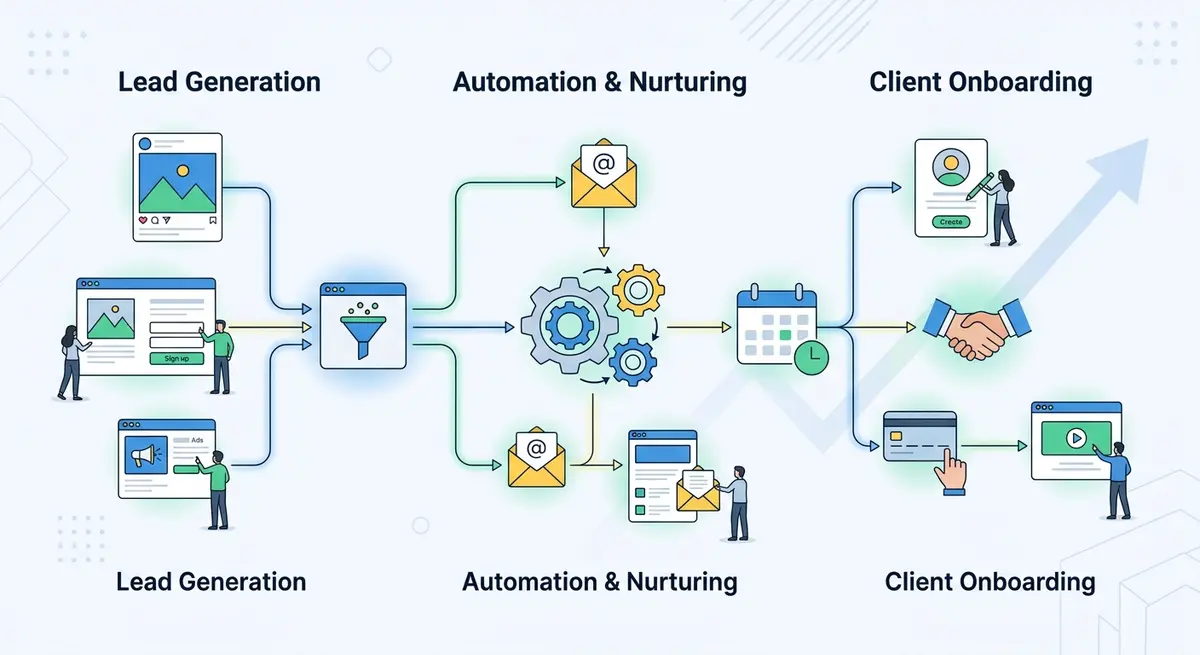
Once your organic process is converting, introduce paid advertising to scale. A standard 2026 acquisition funnel involves running targeted ads to a free resource (a lead magnet or Video Sales Letter), capturing the prospect’s email, and nurturing them through an automated sequence that invites them to book a consultation. Track your metrics meticulously—if your Customer Acquisition Cost (CAC) is $200 and your client Lifetime Value (LTV) is $2,000, you have a highly profitable, scalable machine.
Step 6: Delivering Exceptional Client Results and Retention
Acquiring a new client costs approximately five times more than retaining an existing one. Therefore, your backend delivery system must be as robust as your frontend marketing. Client retention hinges on clear expectations, measurable progress, and consistent communication.
Implement a structured onboarding process that immediately integrates the client into your ecosystem. Within the first 48 hours, they should receive their welcome packet, sign their contract, complete their baseline assessments, and have their first strategy call scheduled. This eliminates buyer’s remorse and sets a professional tone.
To keep clients consistent, utilize behavioral psychology. Celebrate small wins, track objective data points, and provide course corrections before the client feels frustrated. A successful hybrid personal trainer or business coach doesn’t just hand over a PDF; they actively manage the client’s environment and mindset to ensure compliance.

Frequently Asked Questions
Do I need a certification to start an online coaching business?
While the broader coaching industry is largely unregulated, obtaining a recognized certification builds credibility and trust. Specific niches, such as health, nutrition, or financial advising, often require formal credentials or licenses to operate legally and obtain insurance.
How much money does it take to launch a digital coaching practice?
You can launch a lean operation for under $500. Essential initial costs include a domain name, website hosting, basic CRM software, and professional liability insurance. As revenue grows, you can reinvest in advanced marketing and premium software.
What is the most profitable coaching niche in 2026?
Profitability is driven by the urgency of the problem solved rather than the specific industry. However, B2B consulting, executive leadership, specialized health interventions, and wealth management consistently command the highest premium pricing due to their clear return on investment.
How do I transition from in-person to online coaching?
Begin by adopting a hybrid model with your current in-person clients. Move their programming and check-ins to a digital platform while reducing face-to-face hours. Use the resulting case studies to market your fully remote services to a broader audience.
How do I handle clients who don’t get results?
Establish clear metrics for client compliance from day one. If a client fails to achieve results despite following the protocol 100%, you must audit and adjust your programming. If the failure is due to a lack of execution on their part, rely on the accountability systems outlined in your initial agreement.
What is the difference between coaching and consulting?
Coaching focuses on guiding the client to discover their own solutions through questioning and accountability, whereas consulting involves diagnosing a problem and directly providing the expert solution or framework to fix it. Most modern digital practitioners blend both approaches.
Conclusion
Building a digital coaching enterprise in 2026 is one of the most accessible and lucrative pathways to professional independence. By defining a hyper-specific niche, structuring an outcome-based pricing model, and leveraging automated technology, you can scale your impact globally without sacrificing your personal time. Success requires moving beyond simply sharing knowledge and instead engineering an environment where client transformation is inevitable. Focus on mastering client acquisition and delivering undeniable results, and your practice will thrive.
Ready to take the next step in building your digital practice and optimizing your health and business systems? Contact us today to discover how professional guidance can accelerate your growth.